
THANK YOU FOR SUBSCRIBING

Technology to Facilitate Business
× 
Applied Technology Review Weekly Brief
Be first to read the latest tech news, Industry Leader's Insights, and CIO interviews of medium and large enterprises exclusively from Applied Technology Review
Applied Technology Review: Specials Magazine

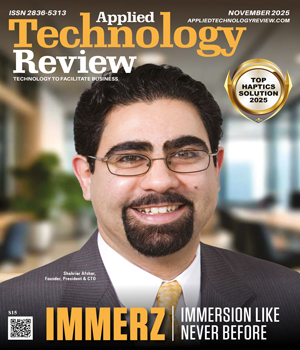
For decades, digital worlds have focused on sight and sound. They show and tell everything, but neglect the physical senses that connect us to reality. Immerz changes that by creating powerful tactile experiences, turning ordinary interactions with games, movies, music and devices into fully immersive moments. The company combines scientific rigor with an intuitive understanding of user experience, making technology that resonates with the mind and body. Users aren’t just observing. They are part of the digital story unfolding around them, experiencing each moment as if it were real. “Visual displays have reached beyond-retinal resolutions where further improvements are negligible. Haptic technology hasn’t matched that progress, and our goal is to bring touch realism to all platforms. We believe our technology will usher in a new era of mobile media immersion,” says Shahriar Afshar, founder, president and CTO. FROM DORM ROOM DISTRACTION TO DIGITAL IMMERSION The story of Immerz began in a university dormitory in 2004 with a solution to a seemingly minor problem. Video games played by students caused vibrations that traveled through the building, disturbing everyone. What could have been a simple annoyance became the spark for a new line of thinking. Afshar, a physics professor grounded in neuroscience and world-famous for his experiments in quantum mechanics at Harvard University, began exploring how vibrations could be transformed from disruptive noise into something meaningful. Early research focused on how the body perceives vibration through nerves connected to the limbic system, the center for self, emotions and behavior. Even subtle tactile signals could make users feel part of the action. The challenge was to develop technology that felt natural, precise and emotionally resonant, avoiding repetition or artificiality. In initial experiments, existing vibration units failed because they lacked texture, complexity, and proper synchronization with audio. Small buzzes could distract rather than immerse, and repetitive effects quickly lost appeal. Afshar discovered that combining sound and touch with exact timing could evoke profound emotional responses. A virtual keystroke, drumbeat, a distant footstep, or an explosion could feel real. These insights culminated in his creation of a new chapter in haptics, now called acousto-haptic technology. Every vibration, every subtle cue, every impact is timed with precision, giving users the sensation of being physically present within a scene. The technology turns touch into a core part of the experience, completing the story that began with dorm room vibrations and ended with a new way of feeling the digital world.
Satellite Communication Solution
DataPath, a Gilat company and leading provider in satellite communications (SATCOM) solutions, is paving the way for next-generation capabilities with its 30+ years of industry experience. Its tried-and-tested ground systems and modem technology form the foundation for new offerings that fortify the company’s position as a go-to partner for defense end-users. Historically, defense sectors in the U.S. and allied nations relied on geostationary satellites with commercial frequencies like Ku and C bands. These required large dishes that made them less mobile. Recently, the focus shifted to medium earth orbit (MEO) and low earth orbit (LEO), with companies like SES, Starlink, OneWeb, Amazon Kuiper and Telesat deploying satellite constellations in these proximities to offer improved capabilities. This change is driving a pronounced need for advancements in satellite technologies. Capitalizing on the demand for advanced satellite technologies, DataPath’s next-gen antennas connect to multiple networks even in highly contested or congested environments. They enable tactical forces to flexibly, rapidly and reliably connect to new orbits and gain much-needed visibility. DataPath’s solutions also feature new modem technology and multi-orbit compatibility (Ka and Ku bands at MEO and GEO) that offer extensive resiliency and portability, representing a significant advancement in SATCOM technology. Like all of their products, they are made in the United States in their Atlanta, Georgia state-of-the-art production facility. Our advancements in transportable Our advancements in transportable ground systems and multi-orbit modem technology provide for reliable, resilient and secure communications when connectivity is most critical ground systems and multi-orbit modem technology provide for reliable, resilient and secure communications when connectivity is most critical,” says Nicole Robinson, president.

Underwater Fiber Optic Connection System

Subsea industries operating in extreme ocean conditions require rugged, reliable fiber optic wet mate connectors. Whether it’s oil and gas, renewable energy, or defense, these connectors are essential for uninterrupted data transmission. However, today’s traditional solutions often fall short. Designed for a simpler era, most can accommodate at most 1 to 12 optical fibers and lack the scalability needed to meet modern demands. Additionally, they are prone to misalignment during mating, leaving them vulnerable to contamination by sand and grit, which compromises performance and reliability. The demand for high mateability, centerline actuation, and debris-resistant double seals is greater than ever. Meeting these requirements demands top-tier engineering and R&D expertise, which significantly narrows the field of capable providers. What most saw as an obstacle, Deeplinc envisioned as an opportunity to innovate and set a new standard. A PIONEER IN SUBSEA CONNECTIVITY SOLUTIONS Deeplinc offers an exceptional portfolio of connectors that meet exacting standards. Its product range caters to diverse industry needs while pushing the boundaries of underwater fiber optic technology. Deeplinc has developed a novel, compact fiber optic wet-mate connector capable of supporting up to 48 fibers in small configurations and scaling up to 144 in larger designs, combining robustness with flexibility.
CXO INSIGHTS

How High Speed Connectivity is Enabling IOT
Mike Tryson, CTO & Vice President of Engineering, TE Connectivity
From Music to Mastery
Jeff Meacham, Sound Designer, Scopely

Don't Forget about the Human Element!
Jolene Stewart, Executive Director of Security and Surveillance, Snoqualmie Casino and Hotel

Navigating AI and Investment Management
Argyro (IRO) Tasitsiomi, Head of AI, Investments Data Science & Research, T. Rowe Price [NASDAQ: TROW]

Invisible Architecture Enriching Hospitality Where Guests Feel Valued
Jon Mcmillian, VP of Marketing and Ecommerce, Ad1 Hospitality

Bridging the Digital Gap in Aviation Sustainability
Andrew Ibsen, Duty Maintenance Manager, British Airways

How Virtual Reality Can Help Real Estate Clients Make Faster, Smarter Decisions
Will Adams, Emerging Technologies Developer, Mortenson


IN FOCUS

Real-World Impact of Haptic Solutions
Haptics technology enhances human-machine interaction by adding tactile feedback, making digital experiences more intuitive and realistic across various applications like consumer electronics, healthcare, and virtual reality.

Reimagining Digital Experience Through Haptic Feedback
Haptic technology is transforming interactions with digital systems, enhancing user experience and safety across various industries through touch, from gaming to healthcare and engineering applications.
EDITORIAL
Engineering Touch for Next-Generation Interfaces
The technology sector is experiencing a remarkable shift, driven by the convergence of immersive experiences, precision engineering and next-generation human-machine interfaces. Haptics solutions are at the forefront of this transformation, enhancing interactivity and bringing digital experiences closer to natural human perception.
Advanced haptic systems deliver nuanced tactile cues that developers need to craft compelling virtual reality, augmented reality and simulation environments. By combining sophisticated actuator technology with fine-tuned feedback algorithms, these platforms are accelerating the adoption of interactive solutions across education, training, entertainment and healthcare. Haptic-enabled devices for healthcare offer precision feedback for surgical simulation, remote procedures and rehabilitation tools.
This edition of Applied Technology Review explores how advanced haptics modules are shaping the future of human-machine interaction.
Featured thought leaders include Pengfei Wang, Principal Engineer of Bess Technology Optimization at RWE and Chris Garrow, Gaming Operations Director at Prairie Band Casino & Resort.
The magazine also spotlights Immerz, a leading provider of haptic solutions, which transforms the way people experience digital content. Its neuroscience-based approach enables users to physically experience moments in games, music, and media, creating deeper emotional and sensory engagement.
We hope this edition inspires new perspectives on how advanced haptics drive innovation across industries.

Top
