
THANK YOU FOR SUBSCRIBING

Technology to Facilitate Business
× 
Applied Technology Review Weekly Brief
Be first to read the latest tech news, Industry Leader's Insights, and CIO interviews of medium and large enterprises exclusively from Applied Technology Review
Applied Technology Review: Specials Magazine
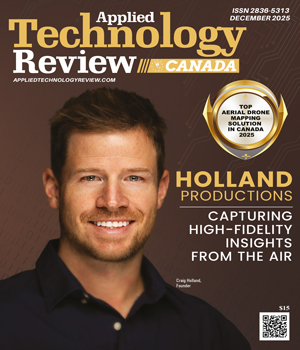
From the ground to the skyline, organizations depend on accurate aerial intelligence to plan smarter and design and operate with confidence. Holland Productions has become the partner they trust. Holland Productions, based in Canada, delivers precise, reliable drone data and aerial imaging, converting each perspective into a competitive edge for professionals who are dependent on accurate visuals. Topographic maps, volumetric measurements and ground models provide the accuracy teams need to plan what comes next, while inspections across roofs, forests and infrastructure reveal the issues that matter before they escalate. And when the job demands a deeper view, LiDAR, photogrammetry and thermal imaging deliver the added insight teams rely on to plan with certainty. Alongside the technical output, the company produces aerial photos and video content for marketing teams and film, media and television productions. While many drone companies focus narrowly on one sector, Holland Productions built its reputation by solving complex challenges across the full landscape of aerial requirements. Construction teams need clear progress documentation, while energy and roofing clients focus on structural health and foresters track environmental conditions. Land planners depend on accurate ground models, and media crews look for polished, intentional imagery. Holland Productions tailors each mission to the enduse case. Flights are engineered to capture multiple datasets in one operation, maximizing value and protecting budgets. Clients don’t have to guess what’s possible. They get a partner who sees the entire problem and aligns the aerial plan to solve it. CONSISTENCY THAT CAN BE COUNTED ON What sets Holland Productions’ services a part from its competition is their ownership of the entire workflow. One internal team manages flight planning, data capture, processing, and final deliverables, giving clients a single accountable partner throughout the project, without compromising data breach. “We collect, process and analyze every dataset ourselves, giving clients consistent quality, tighter data security and deliverables they can trust without the uncertainty that comes Craig Holland, from outsourcing,” says Craig Holland, founder. This in-house model gives the company tight control over quality, performance and data protection. Clients value the assurance that their information stays with one trusted team and that the workflow stays consistent throughout the project. The internal workflow removes the risk of data mismanagement or corruption and ensures clients retain full ownership of their data from start to finish. The approach developed naturally over time as the team saw that outsourcing introduced variables that could compromise accuracy. While many competitors scale through large pilot networks, Holland Productions chooses controlled growth so performance never wavers. It’s a strategic tradeoff that clients appreciate. They get the same standard of accuracy every time, no surprises.
Top Digital Twin of an Organization in Canada 2025
Canadian organizations are under increasing pressure as they navigate rising tariffs, shifting trade policies, and rapid market changes. While technology investments are accelerating, many businesses remain constrained by fragmented planning, siloed data, and decisions anchored in past performance. This complexity demands greater resilience, strategic foresight, and a proactive approach to stay ahead of the curve. In response, progressive organizations are adopting technologies that connect business functions and enhance strategic planning. Digital Twin of an Organization (DTO) rises to the challenge, creating a virtual environment to simulate scenarios, evaluate risks, and drive collaborative change. Originally coined by Gartner®, DTOs help organizations operationalize and better understand their business model. Collaborative Business Planning (CBP) leads in deploying DTO technology, offering a software solution that integrates strategy, operations, and financial performance into a single shared view. By using “decision-timed data” to visualize outcomes and quantify impacts, the software enables organizations to act decisively. “We call DTO ‘testing the future’ because it gives organizations the ability to plan, pivot, and navigate uncertainty with confidence,” says, Mike Haley, VP - DTO Advisory. CBP, built on QualiWare’s Business Management platform, delivers advanced DTO models for actionable operational and financial insights. Unlike traditional digital twins, which focus on real-time monitoring of equipment or production environments, CBP offers a dynamic and comprehensive view of organizational processes and resources. Through this view, business leaders can test-drive decisions across planning horizons and measure their impact before committing resources..

Remote Sensing Equipment Company

Propelled by technology breakthroughs and the push for more efficiency, the wind energy sector is scaling new heights toward a sustainable future. A key innovation driving this change is light detection and ranging (LiDAR), stepping up wind condition measurement and analysis. As wind farms continue to proliferate and are placed in challenging geographies—from complex terrain to coastal waters— LiDAR’s mobility, reliability, data accuracy, safety and ease of deployment make it a compelling choice for wind measurement compared to traditional meteorological masts (met masts). Western Wind Services takes advantage of LiDAR’s indispensable role in wind resource assessments to offer affordable, name-brand LiDAR equipment to different wind power stakeholders across Canada, ranging from developers and consultants to operators and farms. Along with sales and services, the agile company offers rental options, providing clients with the flexibility to dynamically adjust asset needs at various stages of wind project development.
CXO INSIGHTS

BIM 7D Asset Information Modeling: Realizing the Full Potential of VDC
Federico Pensa, Vice President of Technology, Fayolle Canada Inc

Building Authentic Engagement Through Data-Driven Marketing
Deborah Podema, Sr. Digital Marketing Manager, DAP

Building Confidence with Competence
Chris Stamp, Corporate Health, Safety and Environment Manager, MasTec Canada

The Journey to Swift Digital Transformation
John Hill, Senior Vice President - Chief Information Officer, Suncor

Promoting Human Technology
Peter Wheatley, Director of Preconstruction, Metro-Can Construction


IN FOCUS
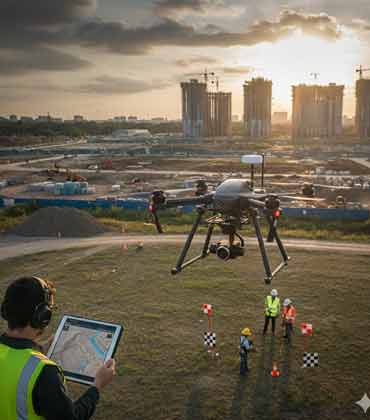
Mapping Canada's Future: Drones as Everyday Industrial Tools
Canada's drone mapping has evolved from novelty to an essential industry tool, enhancing data-driven agriculture, construction, and mining through automation and precise measurement.

Digital Twins of Organizations: Redefining Canadian Public Sector Innovation
DTOs in Canada's public sector promote agile governance by optimizing processes, enhancing operational resilience, and transforming citizen service delivery through predictive analytics and real-time data integration.
EDITORIAL
The New Geospatial Backbone of Enterprise Performance
Digital twins and aerial drone mapping are converging into a single geospatial intelligence ecosystem, where real-world data captured from the air continuously feeds into dynamic organizational models. This integration is reshaping how enterprises plan, monitor and optimize operations, giving decision-makers a unified view that links physical environments with digital performance systems.
Across industries, digital twins are evolving into organizational simulators rather than isolated asset dashboards. Companies now utilize a Digital Twin of an Organization (DTO) to understand how processes behave under various constraints, to test operational strategies before deployment, and to enhance resilience in complex environments. Advances in AI-driven prediction and low-latency data architecture are accelerating this shift, providing executives with faster, scenario-ready insights.
Aerial drone mapping is experiencing a parallel transformation as organizations seek faster, richer and more accurate spatial intelligence. Improvements in LiDAR, multispectral imaging and autonomous flight systems are enabling drones to capture high-resolution data across large or hard-to-reach areas while reducing the cost and risk associated with traditional surveying.
Driven by these trends, the global digital twin market is projected to reach about USD 149.8 billion by 2030, supported by a 47.9 percent CAGR, while the broader drone services market—within which aerial mapping is a major application—is expected to reach approximately USD 57.8 billion by 2028 at a 27.7 percent CAGR.
The magazine features a thought-provoking article from Andrej Butala, Headwalls Construction Manager at STRABAG. In it, Butala discusses how people remain the core drivers of project success and highlights the company’s commitment to safety, wellbeing, development and inclusive leadership. Additionally, an article by Frédéric Leclair, Directeur Senior, Services Dessins / Director, Drafting Services at Canam, explores how the success of digital transformation in construction relies on people and the cultures that empower them to embrace and apply new technologies.
We hope this edition offers perspectives that help industry leaders, policymakers and innovators navigate today’s rapidly evolving digital landscape. In a sector shaped by resilience, collaboration and technological progress, this issue highlights the alignment, innovation and forward thinking that will define the future of connected and intelligent operations.
Let us know your thoughts!

Top
