
THANK YOU FOR SUBSCRIBING
Applied Technology Review: Specials Magazine
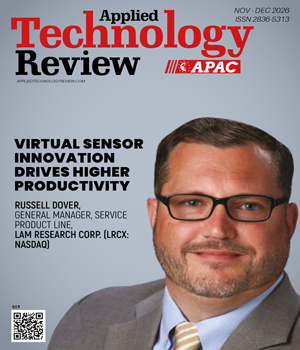
Lam Research Corp. [LRCX: NASDAQ]
Virtual Sensor Innovation Drives Higher Productivity
It takes a lot of different types of process tools to make chips – from deposition to lithographic to etch and cleaning tools, among others. Large-scale production requires chipmakers to use fleets of the same chamber types to perform a particular processing step, such as the fin etch used in making 3D transistors. Ideally, wafer lots would be processed identically across the fleet, meaning every chamber would behave exactly the same as all others. In practice, however, performance will vary from chamber to chamber due to slight differences in the many control parameters that determine the success of the process. These parameters, including pressure, temperature, power delivery, and surface conditions, all have to be co-optimized. The Chamber Matching Challenge The process of bringing performance closer together is called chamber matching. As chip device sizes are shrinking and process tolerances are getting more stringent, the challenges associated with chamber matching are increasing. Traditional methods have included a “golden chamber” approach or sub-component matching. The golden chamber method involves defining one chamber as ideal and attempting to tune all others to produce the same results. Sub-component matching focuses on the hardware subsystems and defines rigorous tolerance specifications that each chamber has to satisfy. The assumption of this approach is that if all components of each chamber match identically, then the chamber as a whole should match. Both of these traditional methods have limitations when it comes to complex physical and chemical interactions of advanced plasma processing. Matching chamber performance requires smart tools and services. A Proven Solution Lam Research’s approach to creating smart tools is to make them self-aware, adaptive, and self-maintaining.The Equipment
Satellite Communication Solution
DataPath, a Gilat company and leading provider in satellite communications (SATCOM) solutions, is paving the way for next-generation capabilities with its 30+ years of industry experience. Its tried-and-tested ground systems and modem technology form the foundation for new offerings that fortify the company’s position as a go-to partner for defense end-users. Historically, defense sectors in the U.S. and allied nations relied on geostationary satellites with commercial frequencies like Ku and C bands. These required large dishes that made them less mobile. Recently, the focus shifted to medium earth orbit (MEO) and low earth orbit (LEO), with companies like SES, Starlink, OneWeb, Amazon Kuiper and Telesat deploying satellite constellations in these proximities to offer improved capabilities. This change is driving a pronounced need for advancements in satellite technologies. Capitalizing on the demand for advanced satellite technologies, DataPath’s next-gen antennas connect to multiple networks even in highly contested or congested environments. They enable tactical forces to flexibly, rapidly and reliably connect to new orbits and gain much-needed visibility. DataPath’s solutions also feature new modem technology and multi-orbit compatibility (Ka and Ku bands at MEO and GEO) that offer extensive resiliency and portability, representing a significant advancement in SATCOM technology. Like all of their products, they are made in the United States in their Atlanta, Georgia state-of-the-art production facility. Our advancements in transportable Our advancements in transportable ground systems and multi-orbit modem technology provide for reliable, resilient and secure communications when connectivity is most critical ground systems and multi-orbit modem technology provide for reliable, resilient and secure communications when connectivity is most critical,” says Nicole Robinson, president.

Geo Satcom Solution
UltiSat
Providing Unified Multi-path Connectivity™ for High Consequence Missions
David Myers, president and CEO
Founded on the principle of customer-centric innovation, UltiSat provides a complete portfolio of remote connectivity solutions tailored to the unique demands of high-consequence missions. For over 30 years, the company has delivered cutting-edge, resilient communications to organizations operating in some of the world's most challenging environments. Its clients range from defense and civilian government agencies to humanitarian aid organizations and critical infrastructure providers. Rapidly emerging new communications technologies, including 5G wireless networks and new low Earth orbit (LEO) satellite constellations, offer promising capabilities for remote users. But separating marketing hype from mission readiness can be a challenge. “We specialize in providing field-proven connectivity solutions for missions that demand the highest levels of performance and security," says David Myers, president and CEO of UltiSat. UltiSat’s ability to engineer bespoke solutions in-house — including satellite, wireless and terrestrial technologies — sets it apart in the market. The company takes a vendor-neutral approach, evaluating the best technology for the mission of developing a tailor-made solution. UltiSat solutions encompass initial design, complete remote equipment, connectivity, user bandwidth, field installation and 24/7 live support. The company’s value proposition is its Unified Multi-path Connectivity™ (UMC) approach. It intelligently combines multiple satellite, wireless and wired technologies into a seamless, high-reliability connection for real-time situational awareness, operational decision-making and personnel safety. This is enabled by UltiSat's Sigma Gemini™ appliance, that optimizes throughput and resiliency through advance software defined networking. For clients operating in remote or contested locations, this type of multi-path reliability is paramount.
Silicon-Cmos Swir Image Sensor Solution
SeeDevice
Innovating for Tomorrow's Industries with Affordable Image Sensors
Dr. Hoon Kim, Founder and CEO
Short-Wave Infrared (SWIR) technology has seen remarkable advancements in recent years, driving innovation across a range of industries, from smartphones and automotive to healthcare and security. While the benefits of this cutting-edge technology are undeniable, the high costs of development and implementation often put it out of reach for many industries, particularly smaller players or those with limited budgets. SeeDevice Inc. is breaking this mold by blending advanced capabilities with affordability The company offers a sensor that detects a wide range of wavelengths using a unique, silicon-based CMOS process. The result is a game-changing SWIR solution that’s transforming sectors from agriculture to healthcare, gaming, and automotive, all without the high costs typically associated with such advancements. A VISION THAT BEGAN ALMOST A DECADE AGO SeeDevice Inc. was founded nearly a decade ago by Dr. Hoon Kim, whose deep experience in technology and research laid the groundwork for the company’s innovation. Before establishing SeeDevice, Dr. Kim served as a professor at the University of Utah and as the director of Nano Quantum Devices Center at KETI (Korea Electronics Technology Institute). With a strong academic background and a proven track record in technological development, Dr. Kim’s move into the private sector was driven by his desire to create practical, scalable solutions for industries in need of advanced imaging technologies. His journey began with the aim of bridging the gap between high-performance imaging sensors and the cost-prohibitive technologies that were limiting their widespread adoption. Prior to SeeDevice’s inception, most image sensors capable of detecting wavelengths across the electromagnetic spectrum relied on rare, expensive materials such as indium gallium arsenide or germanium. These materials were costly and difficult to scale, limiting their availability and affordability for many applications. Dr. Kim’s breakthrough came when he developed a patented technology based on pure silicon. By incorporating the quantum tunnelling effect and plasmonic field enhancement into his design, he was able to create a CMOS image sensor capable of detecting wavelengths from the X-Ray range all the way to short-wave infrared. This groundbreaking sensor has since set SeeDevice apart from competitors and opened new possibilities in imaging. QUANTUM-DRIVEN INNOVATION SeeDevice’s ability to detect such a broad spectrum of wavelengths with precision and affordability makes it unique. The company’s sensors are based on a quantum-driven innovation that combines two fundamental concepts: the quantum tunnelling effect and plasmonic field enhancement.

Geographic Information Systems

Navigating the Future: Geospatial Technology's Impact on Transportation Design
Matt Laluzerne, National Director Of Business Development And Geospatial Services, Mckim & Creed
Drone

Drone Application in Construction Industry
Henry Chan, Deputy Construction Manager, Dragages Hong Kong Limited
Sensor Tech

The Right Leadership Style For Todays Workforce
Lou Windsor, Project Manager, Global Information Technology, Aviagen
Sensor Tech

The Ultimate SAP Cloud Upgrade Playbook
Pete Hogan, Senior Vice President Of Information Technology, Compana Pet Brands
Geographic Information Systems

Crafting the Future with AI, Cloud and Operational Excellence
Damian Ng, SVP of Technology, Head of Enterprise Architecture, Software Engineering, Reliability and Operations, Anywhere Real Estate Inc
Sensing

The Future of Human Interaction with Consumer Electronics: Meeting the Sensor Needs
Neomar Giacomini, Industry Partnerships - Advanced Development and Innovation, Whirlpool [NYSE: WHR]
IoT

E is The Beauty of Esports
Yi Liu, Head of Gaming and eSports, Content+, Mindshare

IN MY OPINION
Video Surveillance
The Rise of Hyper Automation
Erdenezaya Batnasan, Head Of Information Technology Automation and Engineering Department, Khan Bank

LAST WORD
Haptic
Don't Forget about the Human Element!
Jolene Stewart, Executive Director of Security and Surveillance, Snoqualmie Casino and Hotel
IN FOCUS


EDITORIAL
Engineering Intelligent Advantage
Applied Technology Review examines a technology landscape defined by acceleration, integration and rising expectations around measurable business value. Across sectors, digital capability is no longer confined to IT departments but embedded at the heart of operational strategy. This edition explores how enterprises are converting emerging technologies into structured advantage while maintaining reliability, governance and long term resilience.
One clear shift is the maturation of artificial intelligence and advanced analytics from experimentation to disciplined deployment. Organisations are building foundational services that enable consistent use of models across environments, while prioritising data integrity, cost visibility and architectural repeatability. Automation of testing, infrastructure as code and integrated quality controls are strengthening engineering standards. The message is straightforward. Innovation must be anchored in craftsmanship, observability and accountable execution if it is to scale sustainably.
At the same time, operational resilience has become a defining priority. Distributed architectures, cloud native platforms and modular system design are being leveraged to isolate risk and maintain service continuity under pressure. Predictive analytics and virtual monitoring capabilities are extending preventive maintenance cycles, improving uptime and reducing production variability. Technology is being applied not as a theoretical upgrade but as a practical mechanism to safeguard output, protect margins and enhance productivity across complex environments.
Workforce dynamics are also reshaping leadership and organisational culture. As new generations redefine expectations around collaboration, purpose and growth, enterprises are balancing structured governance with more inclusive, service oriented leadership models. Continuous learning, cross functional alignment and clarity of mission are emerging as critical enablers of transformation. The strongest organisations recognise that digital progress depends as much on cultural cohesion as on technical sophistication.
Together, these themes signal a decisive evolution. Strategic adoption of AI, scalable cloud infrastructure and disciplined operational frameworks are redefining competitive positioning. In a climate where speed must coexist with stability, those who integrate technology with intent and accountability will set the benchmark for applied innovation across Europe and beyond.
Top
